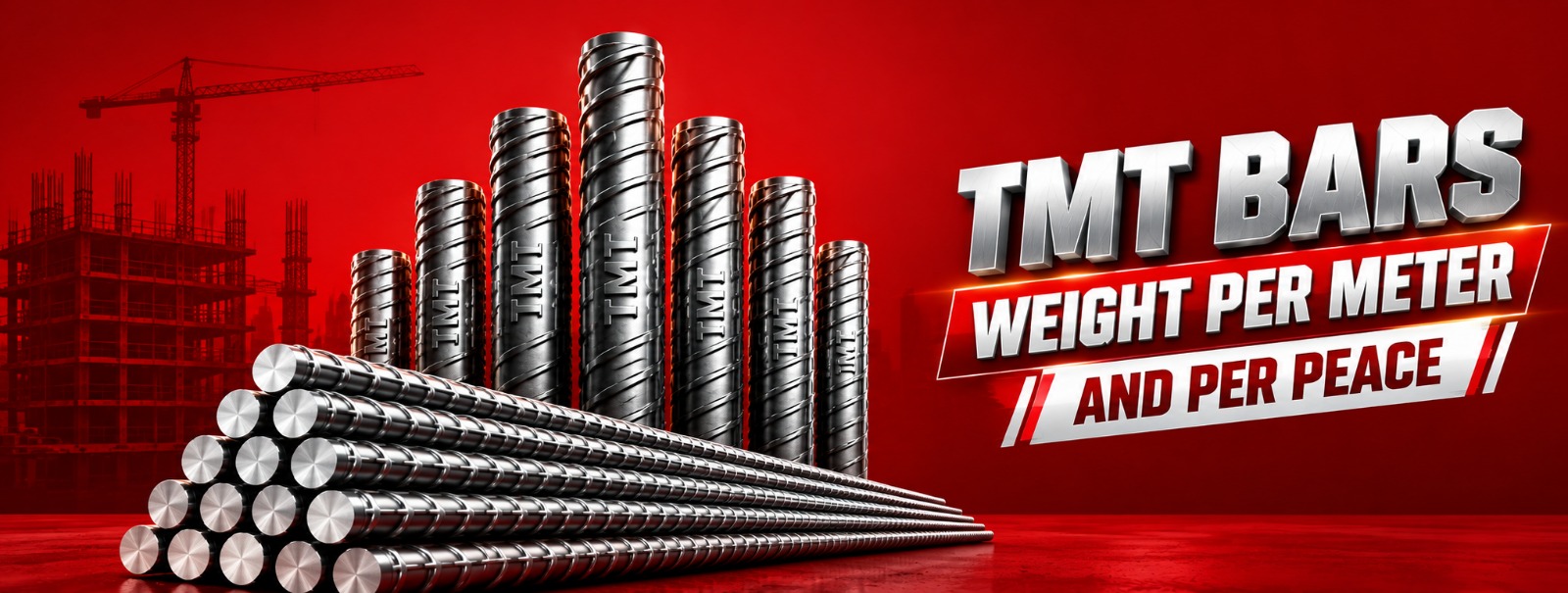
When buying TMT bars for a house, apartment, commercial building or any other construction project, one question often comes up: how much does each steel bar weigh?
Knowing the weight of TMT bars makes it easier to estimate material requirements, calculate the total steel quantity and check a supplier’s bill. It also helps contractors and homeowners plan their construction budget more accurately.
At Maithan Steel, we believe that understanding the material used in construction is just as important as choosing the right steel. A simple weight chart can help you make better decisions before placing an order.
In this guide, we have covered the weight of commonly used TMT bar sizes, from 8mm to 25mm, including the weight per metre, the weight of one standard 12-metre bar and a simple formula for calculating steel weight.
TMT Bar Weight Chart: 8mm to 25mm
The following chart shows the theoretical weight of commonly used TMT bars in India. The per-piece calculation assumes a standard bar length of 12 metres.
| TMT Bar Diameter | Weight Per Metre | Weight Per 12-Metre Bar |
| 8mm TMT bar | 0.395 kg | 4.74 kg |
| 10mm TMT bar | 0.617 kg | 7.40 kg |
| 12mm TMT bar | 0.888 kg | 10.66 kg |
| 16mm TMT bar | 1.580 kg | 18.96 kg |
| 20mm TMT bar | 2.469 kg | 29.63 kg |
| 25mm TMT bar | 3.858 kg | 46.30 kg |
Note: These are approximate theoretical weights calculated using the nominal diameter of the bar. Actual weight may vary within the applicable manufacturing tolerances. Values are rounded for easy reference.
How to Calculate TMT Bar Weight
You do not need a complicated calculation to find the approximate weight of a TMT bar. A simple formula is commonly used by engineers, contractors and steel dealers across India.
Weight per metre = D² ÷ 162
Here, D represents the nominal diameter of the TMT bar in millimetres. The result is the approximate weight in kilograms per metre.
For example, if you want to calculate the weight of a 12mm TMT bar:
- Diameter = 12mm
- Calculation = 12 × 12 ÷ 162
- Weight = approximately 0.889 kg per metre
For a standard 12-metre bar, multiply 0.889 by 12. The result is approximately 10.67 kg.
This formula is useful when preparing a material estimate, checking a steel requirement or comparing the approximate weight of different bar sizes.
TMT Bars Weight based on Size
8mm TMT Bar Weight
An 8mm TMT bar weighs approximately 0.395 kg per metre. One standard 12-metre bar weighs around 4.74 kg.
This size is commonly used for stirrups, ties and distribution reinforcement, depending on the structural design. Although an individual bar is relatively light, the total quantity can add up when several bars are required throughout a project.
For accurate material planning, always calculate the number and length of bars required from the approved structural drawings.
10mm TMT Bar Weight
A 10mm TMT bar weighs approximately 0.617 kg per metre. Its theoretical weight for a 12-metre length is about 7.40 kg.
This diameter is used in various reinforced concrete applications, including slabs and other structural elements, as specified by the engineer.
When estimating the total quantity, remember that the number of bars alone does not determine the final weight. Their length and diameter are equally important.
12mm TMT Bar Weight
A 12mm TMT bar weighs approximately 0.888 kg per metre. A 12-metre bar weighs around 10.66 kg.
This is one of the commonly used reinforcement sizes in residential and commercial construction. Depending on the structural design, 12mm bars may be specified for slabs, beams and other reinforced concrete elements.
If you need 100 full-length bars, the approximate theoretical weight would be:
100 × 10.66 kg = 1,066 kg, or about 1.07 tonnes.
This estimate excludes additional steel required for laps, bends, hooks and wastage.
16mm TMT Bar Weight
A 16mm TMT bar weighs approximately 1.580 kg per metre. One standard 12-metre bar weighs around 18.96 kg.
This diameter is used in structural reinforcement where the design requires a larger bar size, including certain beams, columns and foundations.
For large orders, calculating the approximate weight before purchasing helps with transport planning, unloading arrangements and material reconciliation at the construction site.
20mm TMT Bar Weight
A 20mm TMT bar weighs approximately 2.469 kg per metre. Its theoretical weight for a 12-metre length is about 29.63 kg.
Bars of this diameter may be specified for heavily reinforced beams, columns, foundations and other structural elements, depending on the design.
Because these bars are heavier than smaller diameters, handling and storage arrangements should be planned properly. Follow the engineer’s specifications rather than selecting a diameter based only on its weight.
25mm TMT Bar Weight
A 25mm TMT bar weighs approximately 3.858 kg per metre. One standard 12-metre bar weighs around 46.30 kg.
This is a larger reinforcement size generally used in structural applications requiring substantial reinforcement, as determined by engineering calculations.
For example, 20 full-length bars of 25mm diameter would have an approximate theoretical weight of:
20 × 46.30 kg = 926 kg.
This calculation provides a quick estimate for procurement. The final requirement should be based on the bar bending schedule and the actual lengths needed for the project.
How Many TMT Bars Are There in One Tonne?
The approximate number of full-length 12-metre bars in one metric tonne can also be calculated from the weight per piece.
| Bar Diameter | Approximate Bars Per Tonne |
| 8mm | 211 |
| 10mm | 135 |
| 12mm | 93–94 |
| 16mm | 52–53 |
| 20mm | 33–34 |
| 25mm | 21–22 |
These figures are mathematical estimates, not guaranteed bundle quantities. Actual counts depend on the individual bar weight, permissible manufacturing variation and the supplier’s packing specifications.
For example, one tonne of 8mm bars contains considerably more pieces than one tonne of 25mm bars. This happens because larger-diameter bars weigh more per metre.
Does TMT Bar Grade Affect Its Weight?
A common question among buyers is whether Fe 415, Fe 500, Fe 500D or Fe 550D TMT bars have different weights when their diameters are the same.
The theoretical weight per metre is primarily determined by the nominal diameter and the density of steel. Therefore, bars of the same diameter have approximately the same theoretical weight, regardless of their grade.
However, their mechanical properties, such as yield strength, ductility and elongation, can differ.
For this reason, choosing a TMT bar should never be based on weight alone. The required grade, diameter and other specifications must match the structural design and applicable standards.
How to Check TMT Bar Weight at a Construction Site
When a steel delivery arrives, checking the material properly helps avoid confusion during billing and stock management.
- Check the diameter. Confirm that the supplied bars match the sizes mentioned in the purchase order and structural drawings.
- Confirm the length. The chart above assumes a 12-metre bar. If the supplied length differs, the weight per piece will also change.
- Calculate the expected weight. Multiply the approximate weight per metre by the bar length, then multiply by the number of pieces.
- Compare the delivery records. Check the invoice, delivery challan and weighbridge records, where applicable.
- Consider permitted variation. The theoretical weight is a reference value. Manufacturing tolerances under the applicable standard must be considered before deciding whether a difference is acceptable.
If the measured weight differs significantly from the expected quantity, recheck the bar length, diameter, weighing method and documentation before reaching a conclusion.
Final Thoughts
A TMT bar weight chart is a useful reference for anyone planning construction work in India. Whether you are estimating 8mm bars for distribution reinforcement or calculating the weight of 25mm bars for a large structural application, the basic formula remains the same.
Check the diameter, confirm the length and calculate the expected quantity before placing an order. For the final steel requirement, use the approved structural drawings and bar bending schedule rather than relying on a general chart alone.
To learn more about TMT steel and reinforcement solutions, visit Maithan Steel.