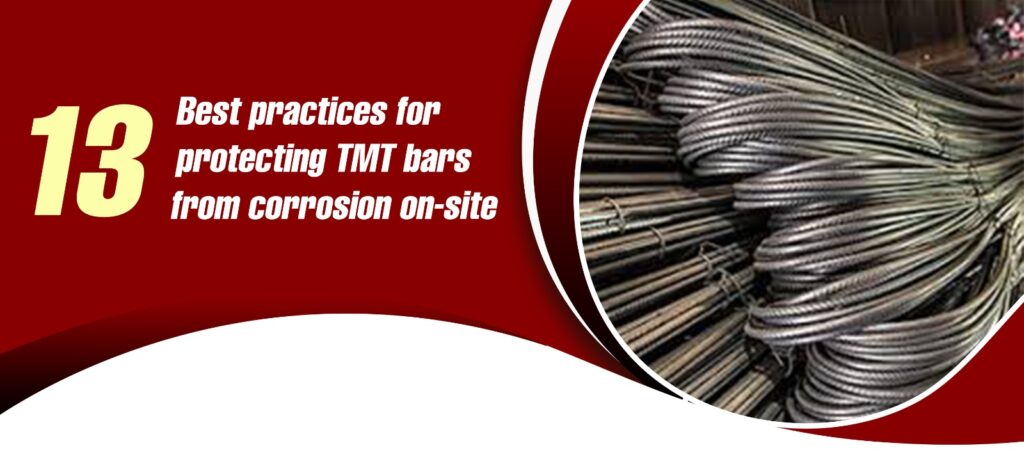
Every year, thousands of buildings develop cracks and weak spots — and most of the time, the real culprit hiding inside the concrete is a corroded TMT bar. Yet there’s so much confusion around what actually protects steel from rusting. Let’s clear up the most common myths with straight facts.
Myth 1: TMT bars never rust.
Fact: No steel is 100% rust-proof, including TMT bars. What good TMT bars offer is corrosion resistance — meaning they rust much slower and hold their strength far longer than ordinary steel. “Rust-proof” is a marketing word, not an engineering one.
Myth 2: All TMT bars have the same corrosion resistance.
Fact: This depends heavily on the chemical composition. Bars made with the right mix of copper, chromium, and other alloying elements resist corrosion much better than plain low-grade steel. Two bars can look identical on the outside and behave completely differently underground.
Myth 3: A coating on the bar’s surface is enough protection.
Fact: Surface coatings can wear off during transport, bending, or tying at the site — and once scratched, that spot becomes a weak point. Corrosion Resistant Steel (CRS) bars build the resistance into the metal itself, so protection doesn’t depend on a coating staying intact.
Myth 4: Corrosion resistance only matters near the coast.
Fact: Coastal air is the obvious risk, but industrial zones, high-humidity regions, and areas with chemical exposure are just as demanding. Even a city with heavy monsoon rainfall and waterlogging puts extra stress on reinforcement steel.
Myth 5: Thick concrete cover alone will stop corrosion.
Fact: Cover helps, but concrete isn’t waterproof forever — it develops micro-cracks over time, and moisture eventually finds its way in. If the bar itself isn’t corrosion resistant, thick cover only delays the problem, it doesn’t solve it.
Myth 6: If a TMT bar looks slightly rusty at the site, it’s poor quality.
Fact: A light layer of surface oxidation on new bars is normal and often harmless — in fact, it can help the bar bond better with concrete. What matters is whether the core strength and corrosion resistance meet standard, not the look of the surface before use.
Myth 7: Corrosion-resistant TMT bars are too expensive for regular homes.
Fact: The price difference between standard and corrosion-resistant bars is usually small compared to the total construction cost. But the savings on future repairs — patching cracked walls, fixing weakened structures — can be huge. It’s a small upfront cost for long-term peace of mind.
Myth 8: Only stainless steel gives real corrosion protection.
Fact: Stainless steel is excellent, but it’s also very costly and rarely needed for regular residential or commercial buildings. For most construction in India, good quality CRS TMT bars strike the right balance between protection and cost.
Myth 9: Once the concrete is set, the corrosion risk is over.
Fact: This is actually when the real test begins. Over the years, factors like cracks, water seepage, and chemical exposure keep testing the steel inside. This is why the quality of the bar at the time of construction matters so much — you can’t “fix” it later without breaking open the structure.
Myth 10: Any ISI-marked bar is automatically corrosion resistant.
Fact: ISI certification confirms the bar meets basic strength and manufacturing standards — it doesn’t automatically mean high corrosion resistance. For that, look for bars specifically tested and rated for corrosion resistance, backed by proper lab reports.
The bottom line: Corrosion doesn’t announce itself — it works quietly inside your walls and columns for years before anyone notices. Choosing TMT bars with genuine corrosion resistance at the construction stage is one decision that protects your building for decades, not just for now.